

‘Supa Dupa Fly’: the album that turned Missy Elliott into a star
In the mid-1990s, Melissa ‘Missy’ Elliott was already shaping R&B and hip hop from behind the curtain. She had been part of the short-lived group Sista, signed to DeVante Swing’s Swing Mob, and had built a reputation as a songwriter and producer for artists like Jodeci, Ginuwine and her close friend Aaliyah.
A brief but unforgettable rap cameo on Gina Thompson’s remix of ‘The Things That You Do’ introduced her playful ad-libs and charisma to a wider audience. Record labels began circling, but Elliott wanted her own imprint rather than a contract as a solo artist.
When Sylvia Rhone at Elektra Records offered to fund Elliott’s label in exchange for one album, the rapper-producer agreed, intending to get it done quickly and return to her work behind the scenes. In the spring of 1997, Elliott and her long-time collaborator Timbaland locked themselves in a Virginia Beach studio for two weeks. Out of that sprint came Supa Dupa Fly, a debut that sounded like nothing else in hip hop.
At a time when the mainstream was dominated by glossy soul samples and formulaic rap, Elliott and Timbaland carved a sound that felt alien and inviting in equal measure. Timbaland’s beats were sparse yet textured, built from unusual percussive clicks, stuttering hi-hats, strange electronic blips and chopped vocal loops. The lead single, ‘The Rain (Supa Dupa Fly)’, floated over an Ann Peebles sample but refused to lean on it, weaving in eerie atmospherics and a hypnotic bassline. On ‘Sock It 2 Me’, a snatch of Delfonics brass became the backbone for a lurching, infectious groove.
Elliott’s delivery matched the production’s unpredictability. She could rap slow and laid back, then snap into double time without warning. Her lines were full of wit, surreal tangents and hooks that doubled as sound effects, like “Beep beep, who got the keys to the Jeep? Vrooooom”, while her singing slipped easily into choruses. This blend of rap and R&B, treated as two sides of the same performance rather than separate genres, was still rare in 1997. Elliott’s approach would become a blueprint for countless artists in the decades to follow.
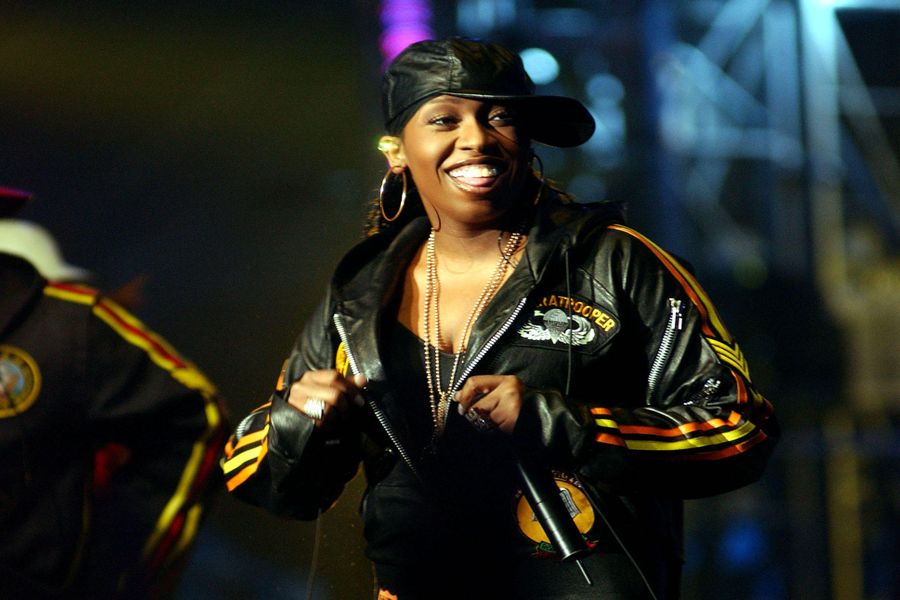
Her refusal to fit into the narrow mould offered to women in hip hop was as radical as her sound. She had no interest in the hyper-sexualised “video vixen” image that dominated the era. In the Hype Williams–directed video for ‘The Rain’, she wore an inflated black patent jumpsuit, turning herself into a living cartoon. The look was part self-parody, part commentary on industry beauty standards, and it made her instantly recognisable.
Her videos for singles like ‘Sock It 2 Me’ and ‘Beep Me 911’ leaned into surrealism and humour, using science fiction set pieces, oversized props and colourful costuming to expand hip hop’s visual vocabulary. Each release reinforced the sense that Elliott was operating in her own creative universe, one where spectacle served the music rather than distracting from it.
When Supa Dupa Fly dropped in July 1997, it went Platinum within two months. Critics praised its innovation, and peers as varied as Janet Jackson and Whitney Houston reached out to congratulate her. More importantly, Elliott’s success proved that a woman in hip hop could lead with originality and command the spotlight without conforming to expectations.
The album’s influence rippled through the industry. Timbaland’s syncopated drum patterns and unconventional sampling became hallmarks of early 2000s pop and R&B. The blend of singing and rapping, once unusual, is now a default mode for many contemporary stars. Elliott’s playful fearlessness opened space for artists who wanted to experiment without losing mainstream appeal.
Over 25 years later, Supa Dupa Fly still sounds fresh. Its beats could slide into today’s charts without feeling dated, and Elliott’s personality bursts through every track. What began as a quick contractual obligation became a defining work of late-90s hip hop and a springboard for one of the most distinctive careers in music. Missy Elliott set out to make one album so she could get back to producing for others. Instead, she changed the game for herself and everyone who came after.