

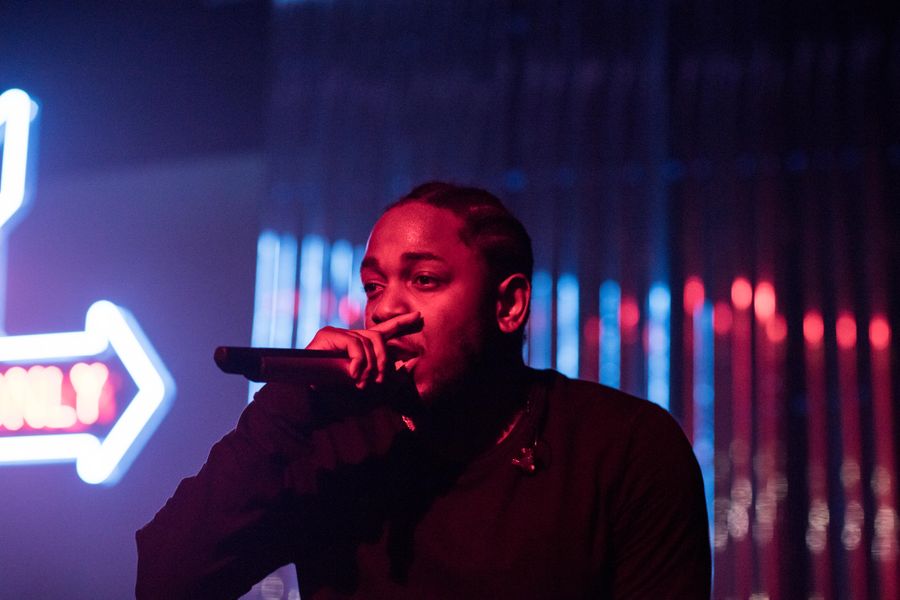
How Kendrick Lamar upstaged Big Sean on his own song
When Big Sean enlisted Kendrick Lamar and Jay Electronica for a verse on his 2013 album Hall of Fame, the Detroit rapper probably had no idea he was about to play a part in one of the most important hip-hop songs of the 2010s. Still riding the wave of the widespread acclaim of his second album, Good Kid, M.A.A.D City, Lamar namechecked 11 rappers during his three-minute verse on ‘Control’ and whipped the industry into a frenzy.
Lamar took aim at several other rising stars and audaciously declared himself on the level Nas, Andre 3000, Jay Z, and Eminem. In saying, “What is competition? I’m tryna raise the bar high / Who tryna jump and get it?” the Californian issues an edict to the industry to try and match him. The challenge has weight because everyone knew Lamar’s talent and artistry were real, and this was a provocation that could not simply be brushed off. It has erupted, dominating conversations on social media and real life, and has drifted from hip-hop circles to mainstream media.
Having been left off the album due to issues with clearing a sample in the song, eventually being released online for free, it completely overshadowed Big Sean’s album, which was a critical and commercial disappointment. From the jump, the song brings intensity and combativeness at a time when the hip-hop industry was fractured. Demographic appeasement and industry politics were priorities for a rapper to garner fame – Lamar’s bold verse switched the focus.
Before he even mentions any names, claiming New York’s throne is one of Lamar’s aggressive lines. Doubly so, he calls himself the offspring of Makaveli in the same breath, referencing not only his bond to the legendary Tupac Shakur but igniting the East Coast–West Coast hip-hop rivalry within which Tupac was a focal point. Of course, any beef between East and West was a far cry from the lethal beef of the 1990s, and naturally, calling yourself the “King of New York” does not have the same hostility it once did. And so the real talking point and what set Lamar aside is who he named and who he didn’t name.
This year saw an extended but dormant feud between Drake and Lamar, which exploded and spawned ten songs between the two aimed at the other. However, 2013 was the time of subliminal shots, where artists made rash boasts about their credentials but rarely targeted peers and rivals. Jabs had been coded and indirect until Lamar’s verse forced the conversation to the forefront. The Toronto rapper was at the time the top contender for hip-hop’s crown and was one of the 11 that Lamar named – alongside J Cole, Big K.R.I.T., Wale, Pusha T, Meek Mill, A$AP Rocky, Big Sean, Jay Electronica, Tyler The Creator, and Mac Miller.
There was fury in Lamar’s voice as he addressed his contemporaries, two of which he was sharing a song with, further demolishing hip-hop’s same team ethos of the era. The latter of the two – Jay Electronica – is a lyrical heavyweight in his own right, and Lamar’s verse reduces him to an afterthought. Sean’s verse was decently underrated, but once it was done, the song was no longer his, and any ownership he had was merely one of legality.
A litany of rappers responded with tracks of their own; however, none of the artists were named. The challenge posed to those named was to up their game and to give fans a better product. Lamar says he’s “got love” for his rivals but wants to “murder” them in the same breath. He throws down a gauntlet that he knows can make the industry better as a whole. Over ten years later, with the experience of his and Drake’s feud behind us, it’s a reminder of the ambition and aggressiveness that Lamar houses. Just like on ‘Not Like Us’ Lamar at his most fierce is unmatched, and truly a catalyst.