

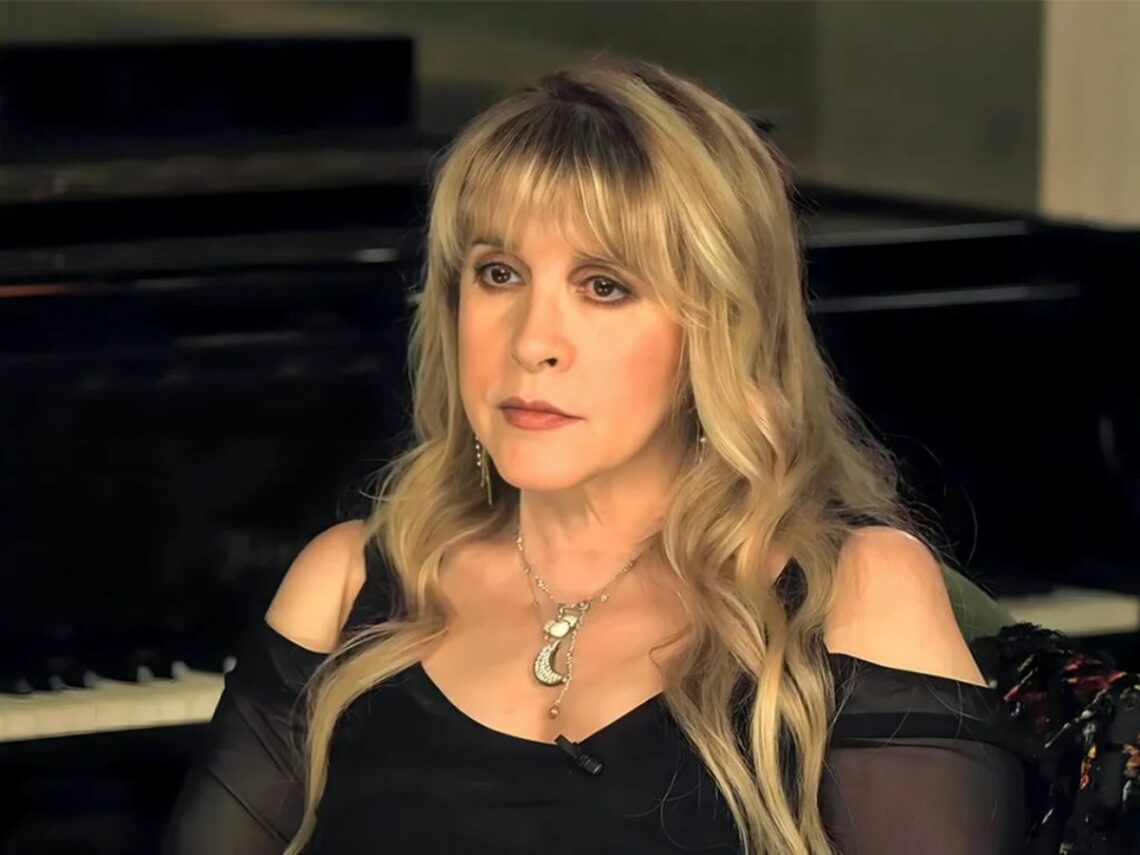
The surprising rapper Stevie Nicks called “my favourite”
When thinking about the brilliance of Stevie Nicks, then in all likelihood, you will concentrate more closely on her impressive rock career. However, she has, on occasion, shared her love of rap too.
From their genesis as a blues rock band under Peter Green’s leadership, Fleetwood Mac transformed throughout the 1970s into a soft-rock phenomenon. The induction of the American couple Lindsey Buckingham and Stevie Nicks ignited this second and most commercially successful chapter for the band. The pair brought plenty of drama and songwriting material to the band, which guided three seminal albums between 1975 and 1980.
Nicks and Buckingham first met as high school students in 1966. The former ran into the latter at an after-school Young Life gathering where Buckingham was performing a cover of Barry McGuire’s ‘California Dreamin”. Nicks decided to join him in vocal harmony, and an intense romantic relationship ensued. As the young couple made early moves in their own musical aspirations, they were inspired more than any other by the country rock band Eagles.
In 2011, Nicks appeared on the BBC’s radio feature ‘Tracks of My Years’ to discuss some of her favourite songs. Eagles’ ‘Witchy Woman’ was the first song to milestone her career. “The Eagles were famous before Lindsey and I moved to Los Angeles,” Nicks said, introducing the song. “We drove to LA, and I remember listening to that song, thinking what a great song it was, and of course, I’m sure as all women my age did at that point, we were all hoping that we would actually be the witchy woman.” Nicks would later befriend and date the songwriter Don Henley, and she felt her affinity with the song was a premonition of sorts.
Continuing, Nicks explained how the Eagles were a crucial influence for her and Buckingham as they released Buckingham Nicks in 1973 and made their first steps towards fame with Fleetwood Mac. “The Eagles were very inspirational to both Lindsey and I because we loved their singing, and we loved their ability to bridge country and rock and roll so beautifully,” she said. “I thought ‘Witchy Woman’ was just the perfect mix of country and rock and roll.”
Although Nicks’ career was rooted in country rock, her songwriting continued to develop into fruitful solo exploits. Furthermore, Fleetwood Mac welcomed new and experimental influences in their latter albums. In 1985, Nicks was particularly impressed by Kate Bush’s progressive yet popular work on Hounds of Love. “I just really loved her because she was a woman songwriter, and she was really standing out from the fray… a real serious writer who could compare with any of the guys,” Nicks said, picking out ‘Running Up That Hill (A Deal With God)’ as a favourite. “She was tough, and yet she was a beautiful dancer, and she wrote beautiful songs. She wrote interesting, on-the-edge songs.”
Heading into the 1990s and the early 2000s, Nicks kept a steady finger on the pulse of popular trends. Her final two milestone favourites were Vanessa Carlton’s pop ballad ‘A Thousand Miles’ and Justin Timberlake’s contemporary RnB classic ‘Cry Me a River’. Nicks’ love for Timberlake and his NSYNC pals in the late ‘90s and early 2000s was rivalled by a taste for hip-hop.
Speaking to Tavi Gevinson in a 2022 interview for The New Yorker, Nicks discussed her creative process. She revealed that listening to music helps her when she’s feeling down and, in turn, inspires her creativity. “Whenever I’m depressed, I just put music on. The second I walk into my dressing room, I plug my iPod into my old-fashioned stereo, and I just crank the music,” she said. “That’s just feeding my soul so that I can get ready to walk onstage in three hours.”
Elaborating on her process, Nicks revealed she is a big fan of ‘Starboy’, the collaborative single by The Weeknd and Daft Punk. “I have crazy musical taste,” she continued. “I have my tapes that go back to the early 2000s—Nelly was my favourite. Because I play my music so loud, everybody at the shows—you know, all the security people and the people that work at the venues—they’re, like, ‘Who is she!?’”