

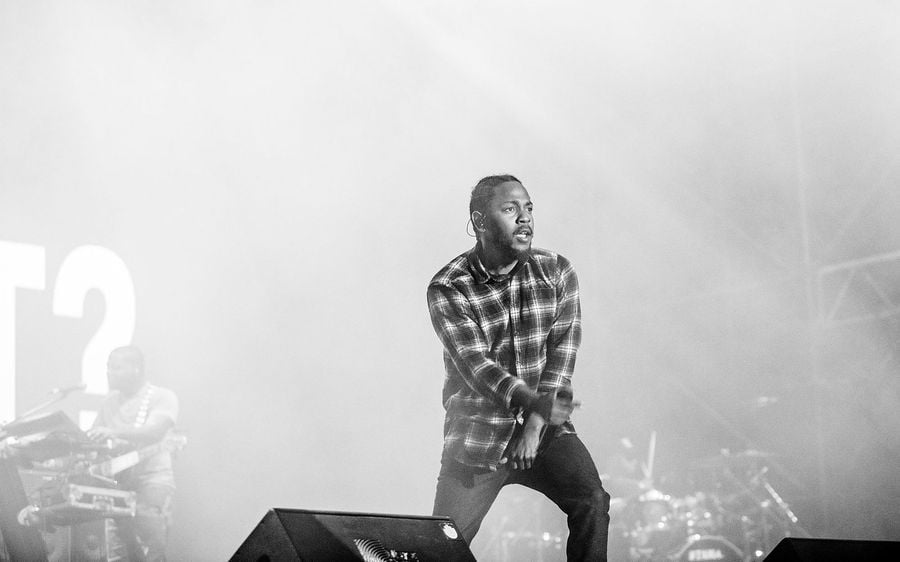
Kendrick Lamar explains why he’s “Compton’s human sacrifice”
Kendrick Lamar’s hometown of Compton has shaped the man and the musician that he is today. The city means a lot to him, but that doesn’t mean he is blind to its darker side.
In 2013, the year after his second album good kid, m.A.A.d city came out and made him a superstar, Kendrick sat down for a conversation with Erykah Badu for an Interview magazine feature. The chat captured Kendrick at a very strange point in his life, with his fame and fortune having only recently reached new and extreme heights.
At one point, Badu asked the young rapper, who was still only 25 at the time, about Compton and his life growing up there. He explained that he was surrounded by family members as a kid, with so many of his aunts, uncles and cousins all living in the same “two black neighborhoods in Compton,” which, in essence, made it seem like “we were the neighborhood.”
He admitted that life here could be intense, filled with “parties, drinking, smoking, violence,” but he was “oblivious to it because I felt like it was just life.” Kendrick, luckily, never got pulled too deeply into these darker goings-on as a child, which meant he was able to maintain a certain youthful innocence that imbued him “the ability to be a dreamer.”
“That’s what separated me from all my homeboys,” he told Badu. “The fact that I didn’t get caught inside the reality. I was always dreaming about doing something else or going somewhere else.”
Badu later asked Kendrick about a lyric from the song ‘m.A.A.d city,’ in which he refers to himself as “Compton’s human sacrifice.” She wanted to understand why he characterised himself this way.
“Probably one of the hardest things to do was to actually do something positive coming from that space,” he said of Compton. “It was so easy for me to dabble in everything else that my homeboys was doing, just being in the middle of the fire. So I felt like that was the sacrifice—for me to come out of that and do something positive.”
In other words, Kendrick had been exposed to the darker temptations of life that Compton had to offer him, but he had, through his music, managed to resist. By rapping and transforming himself into an artist, he managed to avoid the pitfalls that might otherwise have claimed him.
“The moment I made that decision to get in the studio and actually work and study the culture of hip-hop,” he said, “then everything just started to open up and blossom for me.”