

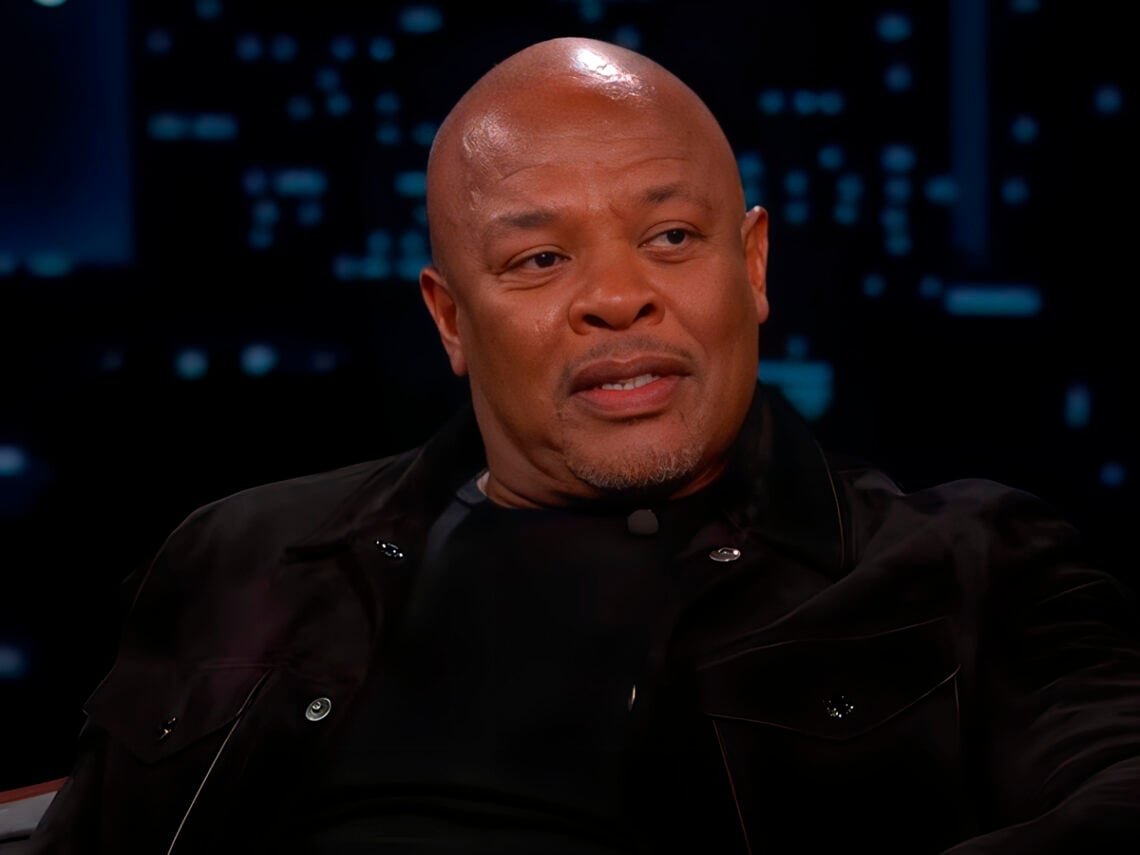
The gang references Dr Dre was forced to remove from his Super Bowl show
The Super Bowl halftime show in 2022 demonstrated just how far hip-hop has come since its early days.
Headlined by Dr Dre and many of his most famous collaborators, it was the first Super Bowl performance to focus solely on hip-hop—proving how central to the mainstream that the genre has become. But, even so, that doesn’t mean that the performance didn’t face pushback from the NFL. There were some phrases and references in the songs that, while quite typical for hip-hop music, nonetheless were forced out of the performance.
Joining Dre onstage for the show were fellow headliners Snoop Dogg, Eminem, Mary J Blige, and Kendrick Lamar, plus guests 50 Cent and Anderson .Paak. The performance was a big deal, obviously, and it was very well received. It was the sort of achievement that would have been unthinkable back when Dre was starting out in the rap game. It marked hip-hop’s place as a central force of popular culture.
But, as Dre revealed after the performance had taken place, there remain certain elements of hip-hop that the mainstream still finds difficult to stomach. Course language and certain themes tend to still make certain people wring their hands—particularly the organanisers of the halftime show.
According to The Washington Post, five of the six performers that year had to alter their lyrics in order to keep in line with the standards set by the organisers. Of the roughly 100 words and phrases that were changed, around half had belonged to Kendrick. Considering he only performed sections of two of his tracks, the changes were fairly significant to his overall performance.
The n-word was predictably a source of discomfort for the NFL, and that was changed throughout the whole show. Kendrick, for example, had to change it 12 times during his part, swapping the term for words or sounds like “ah!” “pr” or “huh?”
Kendrick also had to change specific references to famous LA gangs. In the song ‘m.A.A.d city,’ which he performed during the show, Kendrick should have said the line, “If Pirus and Crips all got along,” but he wasn’t allowed to. The NFL intervened to stop him from mentioning this famous street gangs.
Dr Dre addressed this in an interview with TMZ after the performance, striking a sanguine tone. “No big deal, we get it,” he said of the NFL’s perspective.
The history of hip-hop is certainly weighed down by some unsavoury features, such as its frequent misogyny and homophobia. But it also has a tremendous capacity for reflecting the realities of what minorities in America go through. Gang violence is a fact of life for lots of people in the US, and hip-hop does not shy away from it. But, clearly, that fact is considered unsavoury by the organisers of one the most-watched shows on Earth.