

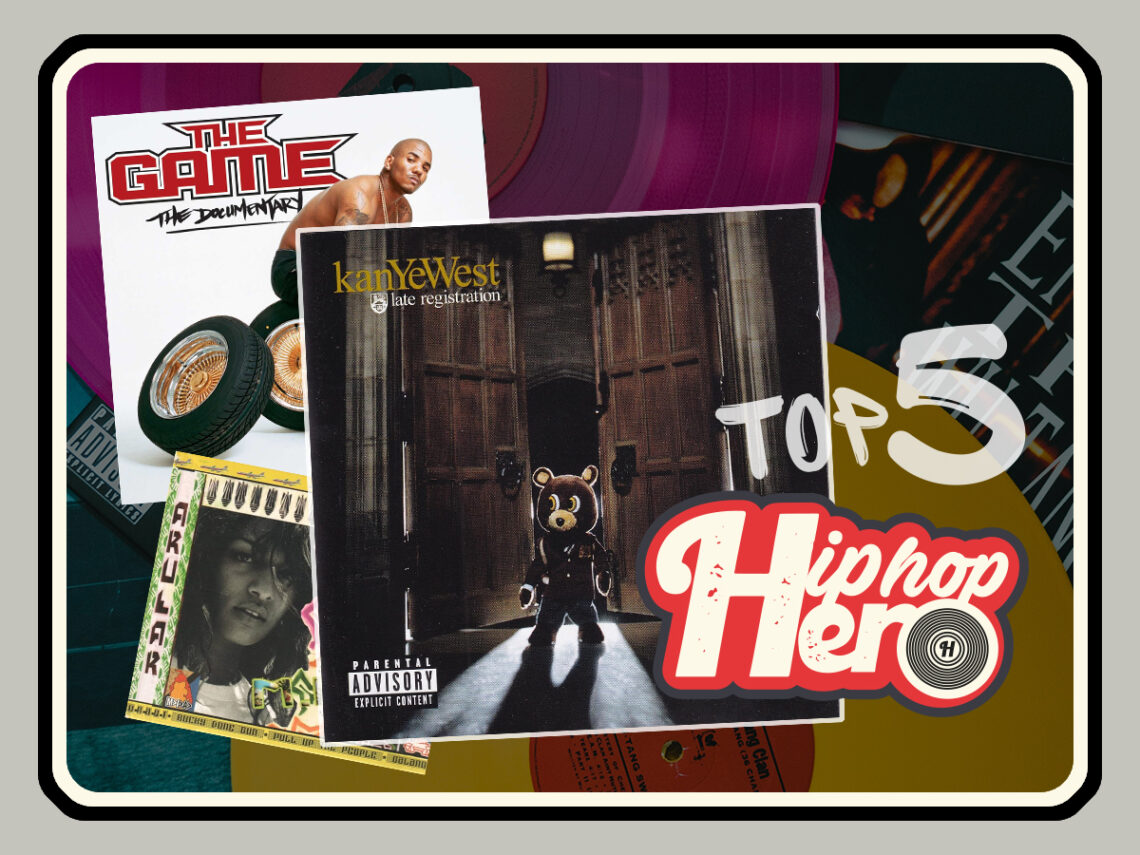
The five best rap albums of 2005
The turn of the new millennium was a significant time for rap music. As the 1990s gave way to the 2000s, hip-hop became increasingly popular and new figures rose to dominate the scene. The old-school days had definitively ended.
50 Cent is probably the Y2K rapper that best embodies the sound and sensibility of the era. While he’d been working within the music scene since about 1996, it was only with the release of his debut album, Get Rich or Die Tryin’, in 2003 that he became a true era-defining star. He followed this up with The Massacre two years later, which, again, was a huge success, but it arguably wasn’t as good as other rap albums that came out that same year.
TI had also become really popular during the early 2000s, as had figures like Ludacris, Nelly and Lil Wayne. Some of these artists released music in the year 2005 specifically, with Wayne’s Tha Carter II arriving towards the end of that year and really sparking his rise to mainstream success. But, while successful in its own terms, it wasn’t necessarily the best record from that year. The competition was stiff.
Some now-legendary figures released albums in 2005, several of which were debut efforts. Here are five of the best and most influential records from that year, which marked a new chapter in the history of rap music.
The five best rap albums of 2005:
5. The Game – The Documentary
By the late ’90s and into the ’00s, Dr Dre was one of the most dominant forces in hip-hop, largely due to the release of his own 2001 album and the fact that he was overseeing the success of his protege Eminem. But it had been a long time since a genuinely new figure from California had emerged to send shockwaves through the scene. But that changed when The Game dropped his debut album, The Documentary, in 2005. It went straight to number one in America, and, with that, a brand new star from Compton had been born.
The album featured production from lots of notable figures, but most interesting, perhaps, was the beatmaker behind the track ‘Dreams.’ Kanye West made that one, and he did so at a time when he was becoming a star in his own right. But before working with him, Game didn’t even know that Ye was a rapper. He learned the hard way, after getting into a friendly freestyle battle with him shortly after they first met. As Game recalled to Complex, “When I say that if I ever lost a freestyle battle, that’s the one I lost. Because Kanye got in my ass, bitches was laughing, and shit was just fucked up and crazy man.”
4. Common – Be
Common was already an old-timer by the year 2005, having released five studio albums since 1992. But his sixth, Be, arrived in May that year, and it was arguably the crowning achievement of his career. It entered the Billboard 200 at number two, while it received great reviews and several Grammy nominations, too. It secured Common’s place in rap history, but, again, just like The Game’s record, it was also notable because of the contributions of an emerging superstar producer named Kanye West. He produced most of it, with J Dilla doing a little work on it, too.
Common’s previous album, Electric Circus, had been a commercial disaster, so he needed Be to be a good one. The involvement of rising star Kanye helped to generate interest in the project, and the quality of the music shone through. Ye had helped Common to revive his career, although Common himself wasn’t surprised at his producer’s musical mastery. He’d known him since 1996, while Ye was still in school, and right away his talent had been clear to Common. “He had some kind of hunger that I hadn’t really seen before,” he once noted of the young Ye.
3. MIA – Arular
Arular, MIA’s first ever studio album, incorporated a whole range of genre influences in addition to hip-hop, including dancehall, baile funk, punk and electroclash—the sounds, in other words, that its creator had been hearing her whole life within the cultural hotbed of her native London. The album could feasibly be classified under that vague and nebulous term of “world music,” but, unquestionably, its star rapped on it. It may not straightforwardly be a hip-hop album, then, but it is, among other things, most certainly a rap album.
Speaking to Rolling Stone about the record on its ten-year anniversary, MIA insisted that the its multicultural influences were symptomatic of the period in which she made it. “I think having a worldly cluster of sounds at that time brought way more people into the clubs,” she said. “And it wasn’t a controlled, homogenized—like, a forced ‘industry,’ monetized, money-making thing. It was actually organic… People traveled and wanted to explore different parts of the world and it was just really—it was really amazing.”
2. Danger Doom – The Mouse And The Mask
Danger Mouse and the late MF Doom had at least two things in common: they were both musical geniuses, and they both loved cartoons. They each got to combine those two worlds while working on the Gorillaz album Demon Days, but that experience didn’t quite scratch the itch. So they started Danger Doom, a hip-hop project that was rooted firmly within the world of cartoons. The duo’s only full album together, The Mouse And The Mask, arrived in October 2005, although they also put out an EP called Occult Hymn the following year.
The album is built upon beats created by Danger Mouse, who sampled excessively from cartoons—especially those originally aired by Cartoon Network’s Adult Swim division, which had been operational since 2001. Both Danger Mouse and Doom had already established working relationships with Cartoon Network, with Mouse making music for some of its shows and Doom voicing a giraffe on one called Perfect Hair Forever. The network, then, was happy to let them sample from their programs, which they duly did. It was an extremely niche idea for an album, but, quite aside from anything else, the tracks on The Mouse And The Mask proved to be great.
1. Kanye West – Late Registration
Already featured on this list as a producer, twice, Kanye also gets his own entry for Late Registration, his second album and follow-up to his 2004 debut The College Dropout. Ye had become known for his “chipmunk” style of production on his first album, which sped up soul music vocal samples, and others had started to adopt the technique for themselves.
Ever an innovator, Ye decided to reinvent his sound for album number two, and, in doing so, he pushed hip-hop into places it had never previously been. While remaining a pop record, Late Registration also featured lush string arrangements and instruments that were not typically heard in hip-hop.
To help him along the way, Ye recruited the services of film score composer Jon Brion, whose music he had heard in the movie Eternal Sunshine of the Spotless Mind. Brion didn’t have much experience with hip-hop music at that time, but, all the same, he and Kanye reached some sort of balance together and their album was a huge success. “There are colors and ideas that make [the album] different from average hip-hop,” Brion told MTV following the record’s release, “but Kanye is already different from the average hip-hop guy.” That was certainly true, but, by 2005, he had begun to decisively shape hip-hop in his own image.