

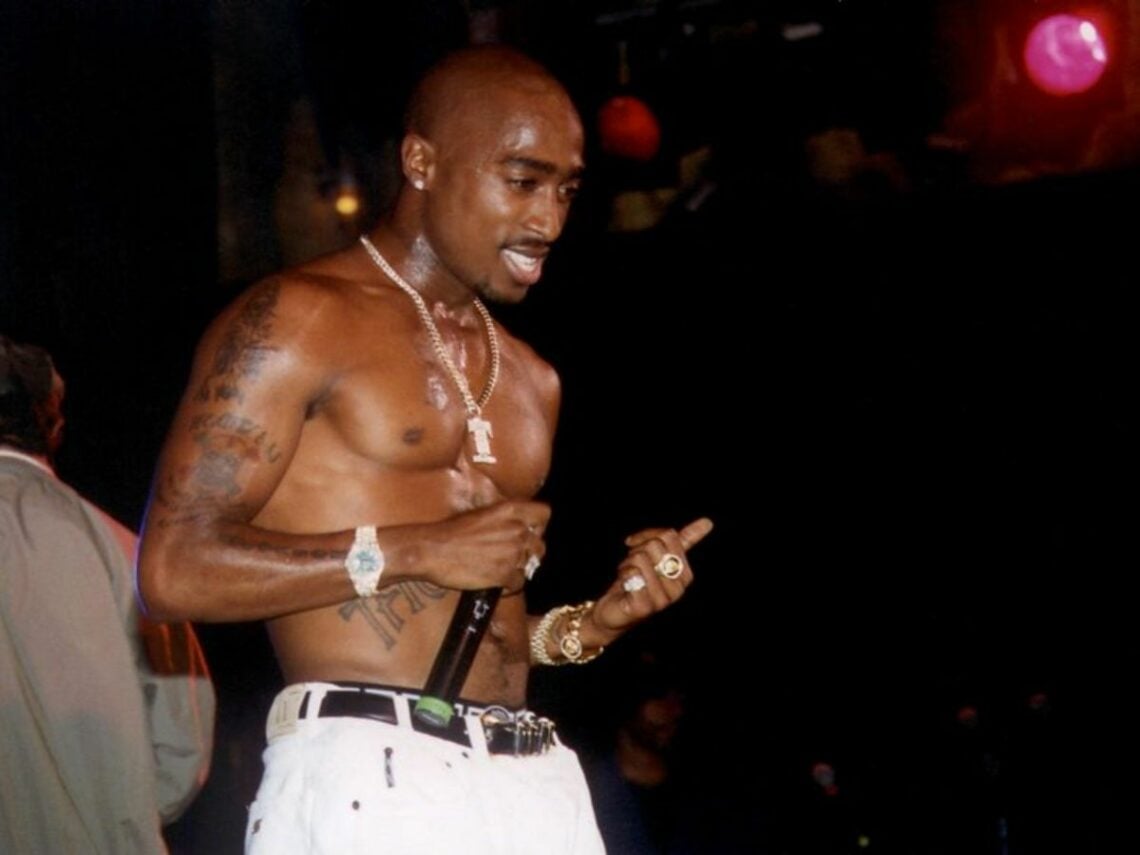
The biggest threat to hip-hop, according to Tupac Shakur
Not only was Tupac Shakur a master of hip-hop, but he was also a student.
He thought deeply about the music and its implications, and some of his ideas would prove to be extremely prescient in the years and decades following his death. He foresaw some of the ways that hip-hop was going to change, and he knew what its threats were, too.
Back in 1991, when he was just beginning to make waves, Pac agreed to do an interview with the hip-hop historian and journalist Davey D. They spoke about a lot of different things, but, at several points in their conversation, the pair zoomed out to assess the general nature and potential future of hip-hop itself.
Davey D asked Pac about his “philosophy on hip-hop,” mentioning that 2Pac had previously claimed that he didn’t want to see the scene become “diluted.” But Pac, whose first album and first movie appearance occurred the very same year that this interview was conducted, had already moved on from this previous stance.
“Now I have a different philosophy,” he said. “Hip-hop, when it started—it was supposed to be this new thing that had no boundaries and was so different to everyday music. Now it seems like I was starting to get caught up in the mode of what made hip-hop come about. I would walk around and hear something and start saying, ‘That’s not hip-hop.’ If someone started singing, I would walk around and say, ‘That’s not hip-hop.’ Well, now I’ve changed my mind. That could be hip-hop. As long as the music has the true, to-the-heart soul, it can be hip-hop. As long it has soul to it, hip-hop can live on.”
Tupac, already by this early stage in his musical development, had realised that hip-hop was an ever-evolving thing, and it wasn’t his place to judge the directions that it moved in. As long as it maintained its “soul,” it would remain hip-hop. So, given the developments within the genre around that time—as Davey D put it to him, gangsta rap, Afrocentric rap, raggamuffin and pop rap were all beginning to emerge—Tupac was still confident that the good stuff would endure.
“I think all the real shit is gonna stay,” he said. “It’s gonna go through some changes. It’s going through a metamorphosis so it will blow up sometimes and get real nasty and gritty, then the leeches will fall off and hip-hop will be fit and healthy. Hip-hop has to go through all of that, but no one can make judgments until it’s over.”
That is, pretty much, what would end up happening over the following decades. Hip-hop has become an immensely popular, highly commercial genre, and there is, it’s probably fair to presume, a lot of stuff out there that 2Pac himself would find extremely distasteful. But there’s still some remarkable, inventive hip-hop coming out all the time—hip-hop with, as Pac would say, with “soul.”
But even though Tupac was feeling positive about hip-hop’s future, he did recognise that it faced challenges. “Egotistical rappers,” he said, in response to being asked what hip-hop’s biggest enemies were. “They don’t wanna open up their brain. It’s foul when people are walking around saying things like, ‘Oakland is the only place where the real rappers come out. New York is the only place where the real rappers come out. They booty out there or they booty over there…’”
It’s chilling to read now, knowing the circumstances of Tupac’s death. He would be shot down and murdered in 1996, a victim of the feud between the East Coast and West Coast. As he stated in this interview several years beforehand, he already understood how such animosity would damage hip-hop terribly. He was right about that, but he still lost his life. “All of that [animosity] just needs to die, or hip-hop is gonna have problems,” he said. “It’s gonna be so immature. That’s just conflict in words. We can’t be immature we gotta grow.”