

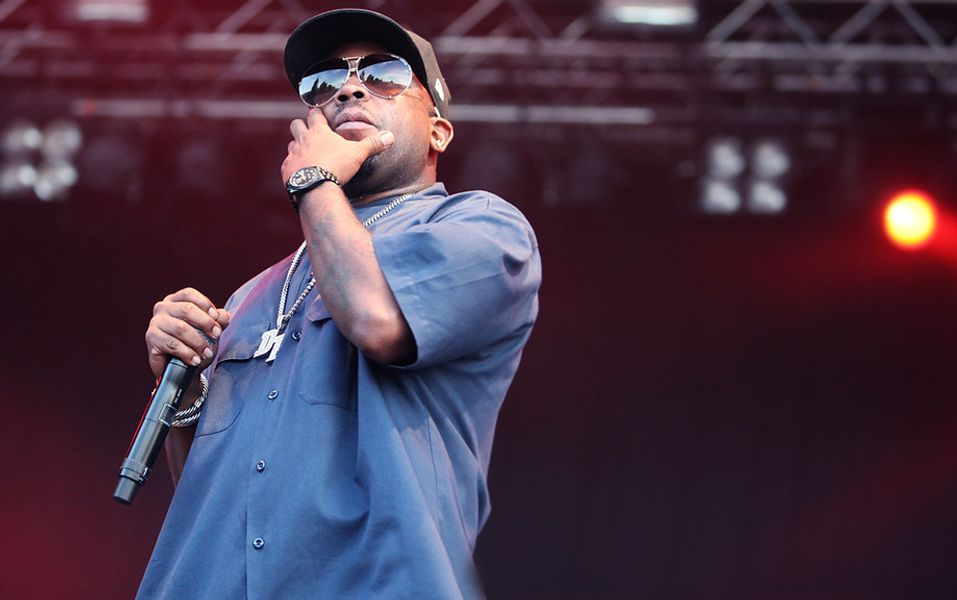
Big Boi’s favourite songs on Outkast’s ‘ATLiens’
When Outkast released their debut album, Southernplayalisticadillacmuzik, in 1994, it didn’t just put them on the map—it also highlighted the strength of Southern hip-hop more broadly.
But it was only with the follow-up album, ATLiens, that the staying power of André 3000, Big Boi, and their wider Southern scene became crystal clear. ATLiens was a serious work of art, and it sent shockwaves through the established hip-hop community.
Hip-hop, until this point, had been dominated by the East and West Coasts, with supremacy perpetually wrestled back and forth between the two. But once Outkast arrived on the scene, things changed. They proved that rap innovation wasn’t confined to New York and California, and that didn’t go down well with those two established hip-hop communities. When Outkast won Best New Rap Group at the 1995 Source Awards, the crowd booed them viciously, but the duo was undeterred. “The South got something to say,” Dré said from the podium. He meant what he said. Outkast released ATLiens the following year.
Reflecting on this booing incident many years later, during a conversation with Spin in 2016, Big Boi said, “I call it the rap civil war. We were the first ones to break through to the North and have them respect us as MCs, our craft, our ability to write lyrics, and have bars. They had to respect it. He spoke it at the award show because they booed, but we didn’t give a fuck. It pissed us off, and they shouldn’t have did that, because it fueled us and threw gas on the fire. But we were already thinking that, because we had to fight so hard to be recognised.”
Big Boi and André 3000 were at least partly driven to create a great second album because of the animosity that greeted them from the established hip-hop community, but it wasn’t the only thing that influenced the record that would become ATLiens. Big Boi and Dré’s respective lives were changing a lot during this period in the mid-’90s, with Dré returning to school to pick up his education and Big Boi becoming a dad, which clearly shaped his view of the world.
“It made me more responsible,” Big Boi reflected two decades after the fact. “My daughter became my number-one priority. It was like the papa bear and his cubs. You would do anything to protect that baby and anything to provide for your family.”
It wasn’t easy, of course. Becoming a dad is difficult for everyone, but it’s especially hard when one’s career is as full-on as Big Boi’s was at the time. He had to learn how to strike a balance between being a rising hip-hop star and a responsible parent, which naturally forced a degree of maturity onto him. “Dré [would] always be like, ‘I love how you just buckled down,’” Big Boi reflected. “Like, ‘Man, goddamn you’re serious about that daddy shit.’ I’m blessed that God put me on this path. It also brought a sense of restraint. Just not being out here wilding.”
With both Outkast members beginning to mature around this time—they were still young men, remember, only just entering their 20s—their music took on a less frivolous vibe than what had come before it. “You’re also going from a teenager to being 20 and you’re looking at life differently because you’re having different experiences,” said Big Boi. “[ATLiens] wasn’t more serious, but we weren’t kids anymore.”
The second album that they produced and ultimately released to great acclaim in 1996 certainly struck a darker tone than Southernplayalisticadillacmuzik, and it included some of the duo’s best songs. But what are Big Boi’s highlights? He was initially reluctant to specify—“That’s like trying to pick which one of my kids is the best kid”—but he did eventually relent and offer up a couple of possibilities.
“Day to day it might change, depending on the mood I’m in,” he said. “One day it might be ‘Wheelz of Steel.’ One of my favorites is ‘Ova Da Wudz,’ because I love how we did lyrical gymnastics all over that bitch. But, you know, it changes from day to day. I just put my iPod on shuffle.”